Hit by a Car in a Crosswalk? What California Pedestrians Should Save
After a California crosswalk collision, preserve signal timing, sightlines, cameras, witnesses, original files, clothing, reports, and medical records.
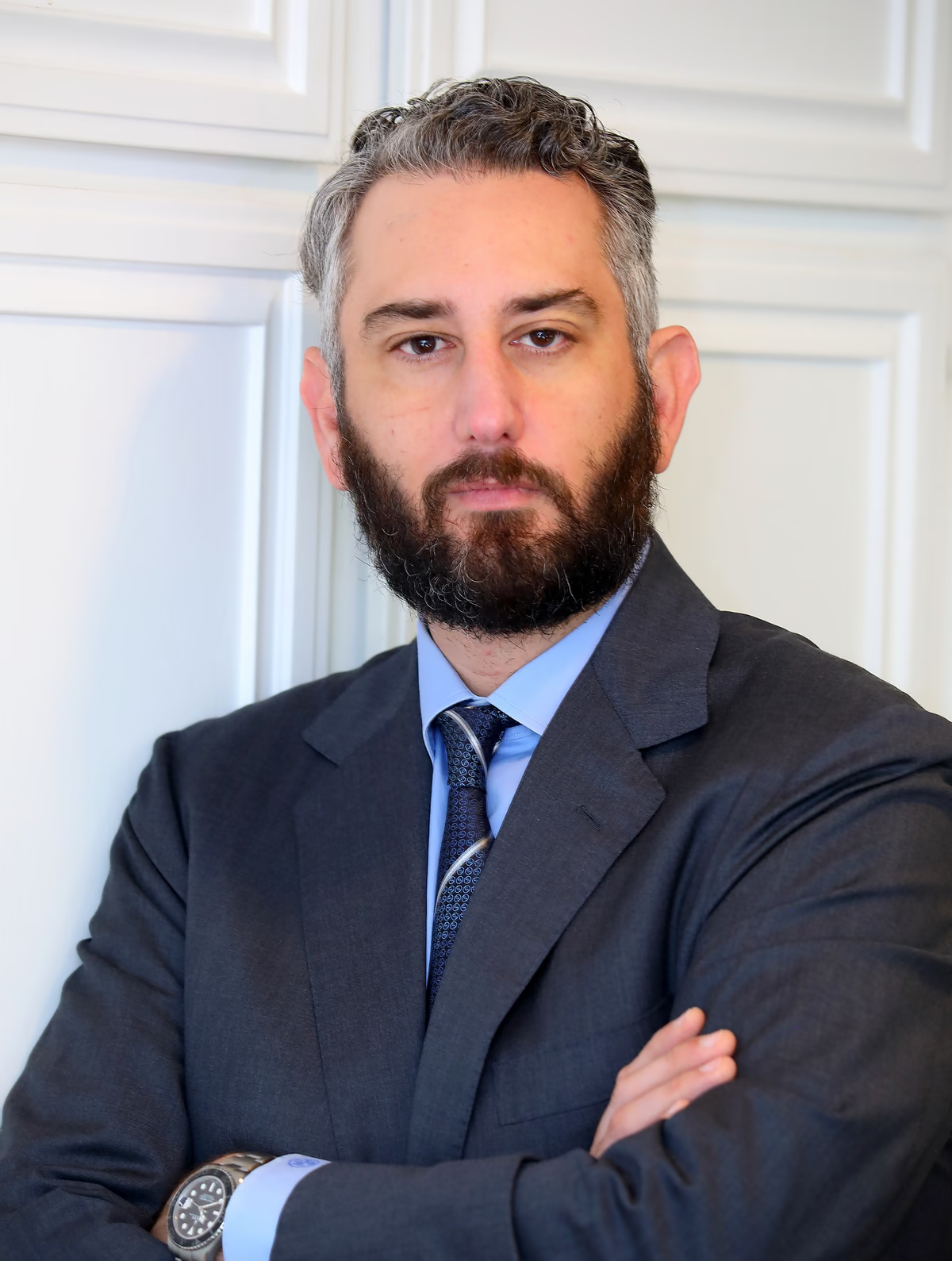
CA Bar #286995 · Admitted 2013
A painted crosswalk may show where someone crossed. It does not preserve what the pedestrian signal displayed, when the person entered the roadway, which way the driver turned, what blocked the view, or where nearby video was stored.
Those details can become the center of a California pedestrian-injury dispute. A driver may say the pedestrian stepped out suddenly. A witness may remember a countdown but not the number. A business camera may overwrite its footage. Repairs, parked vehicles, construction, foliage, and lighting can change the scene.
Safety first: Call 911 for an emergency and get appropriate medical care. Do not enter traffic, return to an unsafe intersection, confront a driver, or delay treatment to collect evidence.
Important: This article provides general information, not legal advice. Crosswalk status, signal instructions, right of way, comparative fault, causation, insurance, public-entity procedures, deadlines, and available evidence depend on the facts. No result is promised.
Record the Exact Crossing, Not Just the Intersection
“Hit near Florence and Lakewood” may identify a busy intersection without identifying the actual crossing.
Preserve, when it is safe:
- the street names and exact corner;
- the direction the pedestrian was walking;
- the direction and lane from which the vehicle approached;
- whether the driver was moving straight, turning, backing, or leaving a driveway;
- where the pedestrian entered the roadway;
- where contact occurred;
- where the pedestrian, vehicle, debris, and personal items came to rest;
- the date and best-known time; and
- police, fire, ambulance, or incident numbers.
A map pin, location history, ride receipt, transit record, or contemporaneous message may help anchor the place and time. Keep the original record rather than relying only on a later screenshot.
A Crosswalk Can Be Marked or Unmarked
California Vehicle Code section 275 defines a crosswalk to include the portion of roadway marked for pedestrian crossing. It also recognizes specified unmarked crosswalk areas at intersections.
That does not make every place where someone crosses an “unmarked crosswalk.” The roadway layout, intersection boundaries, sidewalks, curb ramps, and direction of travel may matter.
Vehicle Code section 21950 generally requires a driver to yield to a pedestrian crossing within a marked crosswalk or an unmarked crosswalk at an intersection. As the driver approaches a pedestrian in such a crosswalk, the statute also calls for reasonable care, reduced speed, or other action needed for the pedestrian's safety.
The same section says pedestrians must use reasonable care. A pedestrian may not suddenly leave a curb or other place of safety and walk or run into the path of a vehicle close enough to create an immediate hazard. A pedestrian also may not unnecessarily stop or delay traffic in a crosswalk.
The driver's duty does not disappear merely because the pedestrian's care is disputed.
The California Judicial Council's 2026 civil jury instruction for crosswalk collisions, CACI No. 710, presents those duties together. Its directions explain that crosswalk crashes often involve comparative-fault questions.
The useful rule is not “pedestrians always win” or “the pedestrian stepped out.” Both are slogans. Evidence decides which facts can be proved.
Preserve the Signal Phase and Timing
At a signalized intersection, photographing the crosswalk lines later does not show what the controls displayed at the time of the collision.
Record as soon as reasonably possible:
- whether there was a WALK symbol, flashing hand, solid hand, or countdown;
- what the pedestrian remembers seeing before entering;
- the countdown number, if anyone reliably remembers it;
- the traffic-signal color and turn arrow for the vehicle's direction;
- whether the driver was turning right or left across the crossing;
- whether any signal head was dark, blocked, damaged, or difficult to see;
- whether an accessible pedestrian signal produced sound or vibration; and
- each witness's separate recollection, in that person's own words.
Vehicle Code section 21456 governs pedestrian-control signals. Its application can depend on what was displayed and when the pedestrian entered or continued through the roadway. Do not reconstruct a favorable signal sequence by agreement among witnesses. Preserve the uncertainty.
Signal timing and phasing records may exist for some intersections. Maintenance records, timing plans, controller information, complaints, or change logs may be held by different agencies or contractors. Their existence, availability, and retention should be investigated rather than assumed.
Photograph Sightlines From Both Directions
The ability to see and be seen can matter as much as the painted lines.
When it can be done lawfully and safely, useful scene records may include:
- wide views along the pedestrian's approach;
- wide views from the driver's likely approach;
- parked cars, delivery vehicles, buses, construction equipment, or traffic queues;
- signs, poles, utility boxes, trees, hedges, outdoor dining, scaffolding, and other obstructions;
- lighting, glare, shadows, rain, smoke, and weather;
- curb ramps, medians, islands, lanes, stop lines, and turn pockets;
- fresh tire marks, debris, damaged signs, or disturbed landscaping; and
- the scene at a comparable time of day.
Do not stand in a traffic lane to reproduce the driver's view. A lawful investigator may be able to document the scene later using safer methods.
Keep close and wide photographs. Preserve the original files with metadata. Cropped, filtered, or annotated copies may be useful for discussion, but they should not replace the originals.
Identify Cameras Without Assuming They Recorded the Crash
Potential video may be controlled by:
- nearby stores, restaurants, apartments, and offices;
- parking-lot or garage operators;
- homes and doorbell-camera owners;
- buses, transit facilities, and stations;
- traffic-management or intersection systems;
- police, fire, ambulance, or public works vehicles;
- the striking vehicle or nearby cars with dashcams; or
- witnesses' phones.
A visible camera does not prove that it was operating, aimed at the impact, recording, or retaining footage. Some traffic cameras provide live views without preserving video. Private systems may overwrite footage quickly.
Record the camera's location and likely custodian. A focused evidence-preservation request can identify the event, location, time window, and requested material. It is not a subpoena, does not prove the evidence exists, and does not force a recipient to provide it outside an applicable legal process.
Avoid trespassing, impersonating an official, or pressuring a witness. Preserve the names and contact details people voluntarily provide.
Save Clothing, Shoes, Devices, and Vehicle Information
Physical and digital records may help connect the impact, movement, visibility, and injuries.
Preserve:
- shoes and clothing without washing, repair, or disposal;
- a bag, glasses, mobility device, phone, or other item damaged in the collision;
- photographs of visible damage and where items were found;
- original phone photos, video, messages, and call logs;
- relevant location, health, fitness, wearable, transit, or navigation data;
- the driver's name, plate, vehicle, owner, insurer, and employer or app information when lawfully available;
- photographs of the vehicle, including windshield, mirror, hood, lighting, and contact areas; and
- tow, storage, repair, inspection, or salvage information that reaches the injured person or family.
Do not alter a damaged item to make it more persuasive. Keep a simple custody record showing who held it and when. If a device must be repaired or replaced, preserve a backup and obtain advice about relevant data before wiping or surrendering it.
A Report, SR-1, and Insurance Claim Are Different Records
A law-enforcement collision report can contain party information, witness statements, a diagram, observations, and preliminary conclusions. It does not decide civil liability by itself. If a report contains a factual error, preserve the original and address the issue accurately rather than editing or hiding the record. Our article on incorrect California crash reports explains that distinction.
The California Highway Patrol allows a proper party of interest, including a pedestrian involved in a reported collision, to request a CHP crash report through its process.
California DMV also has a separate SR-1 accident-reporting process. Whether an SR-1 is required depends on the current reporting rules and facts. The SR-1 is not the police report and does not replace notice to an insurer.
Keep these lanes separate:
- emergency or medical response;
- police or CHP investigation and report requests;
- DMV reporting;
- notice to an insurer;
- an evidence-preservation request;
- a public-records request;
- a government claim when applicable; and
- a lawsuit.
Completing one does not necessarily complete another. If officers did not respond, see our guide to what to do when there is no police report after a California crash.
Comparative Fault Does Not Erase the Need to Investigate
California uses comparative-fault principles. A dispute about a pedestrian's conduct does not end the inquiry into the driver's conduct, and a driver's statutory violation does not remove questions about causation or the pedestrian's care.
The investigation may ask:
- Was the person in a marked crosswalk or a qualifying unmarked crosswalk at an intersection?
- What did the pedestrian and traffic signals display?
- When did the person enter the roadway?
- How close was the vehicle at that moment?
- What did the driver and pedestrian have a reasonable opportunity to see?
- Was the driver turning, distracted, speeding, backing, or failing to reduce speed?
- Were sightlines blocked?
- Did more than one driver, vehicle, property condition, or public feature contribute?
- What injuries and losses were caused by the collision?
If the driver or insurer is blaming the pedestrian, preserve the communication rather than arguing about it. Our article on fault disputes after a California crash explains why an early accusation is not the final allocation of responsibility.
A citation or report conclusion may be relevant. It does not automatically establish negligence, causation, comparative fault, or damages in a civil claim.
Public Roadway or Transit Issues Need a Separate Track
Some pedestrian collisions may involve a public bus, public employee, signal, roadway design, construction project, or alleged dangerous condition of public property. Public involvement does not automatically make an agency responsible.
Public-entity claims can involve different legal theories, procedures, defenses, and early claim-presentation rules. Signal records may be held by one entity while roadway maintenance, transit video, police records, and contractor files are held by others.
Do not assume that a police report, public-records request, complaint, insurer notice, or preservation letter presents a government claim for money damages. Prompt individualized review matters when a public entity may be involved. Do not calculate a personal deadline from a general article.
Preserve Medical and Loss Records
Get appropriate care and keep:
- ambulance, emergency, imaging, medication, therapy, and follow-up records;
- discharge instructions and work or activity restrictions;
- bills, explanations of benefits, receipts, and transportation expenses;
- photographs of visible injuries when appropriate and respectful;
- a dated symptom and treatment timeline;
- missed-work, reduced-hours, and employer communications; and
- insurer, medical-payments, lien, reimbursement, and benefits correspondence.
Do not minimize symptoms to an insurer before the medical picture is understood. Do not exaggerate or self-diagnose. If pain or other symptoms appear later, our article on delayed symptoms after a California crash explains how to document the timeline without turning it into a diagnosis.
For a short checklist you can use today, see the Injury Help guide for a crosswalk pedestrian crash.
Sources
- California Vehicle Code section 275: Crosswalk definition
- California Vehicle Code section 21456: Pedestrian-control signals
- California Vehicle Code section 21950: Duties in crosswalks
- California Vehicle Code section 21954: Crossing outside a marked or qualifying unmarked crosswalk
- Judicial Council of California: 2026 Civil Jury Instructions
- California DMV: Report of Traffic Accident Occurring in California (SR-1)
- California Highway Patrol: Traffic collision guidance and report requests
Bottom Line
After a pedestrian is hit in or near a California crosswalk, medical care comes first. Then preserve the exact route, point of impact, signal display, vehicle path, sightlines, witnesses, likely camera custodians, original files, physical items, reports, and treatment timeline before the record changes.
Do not assume that crosswalk lines automatically decide fault. Do not accept a sudden-step accusation as the final answer either. The evidence should address the duties and conduct of everyone involved.
Law Office of Arta Wildeboer helps injured pedestrians and families in Downey, Southeast Los Angeles, the Gateway Cities, and Los Angeles County evaluate crosswalk evidence, insurance communications, fault disputes, and potential public-roadway issues. Learn about the firm's California personal-injury services or request a free consultation about your circumstances.
Call or text (562) 608-8887 or contact Law Office of Arta Wildeboer online for a free consultation.
Se habla español. Farsi and Filipino/Tagalog assistance are also available.
Past results do not promise any outcome. Contacting the firm does not create an attorney-client relationship unless a written agreement is signed.
Attorney Advertising. This article is for general informational purposes only and does not constitute legal advice. Reading this content does not create an attorney-client relationship. Laws change frequently — consult a qualified attorney about your specific situation.