California Motorcycle Crash: Save the Bike First
Before a crashed motorcycle is repaired or scrapped, preserve the bike, helmet, gear, detached parts, custody records, and digital evidence.
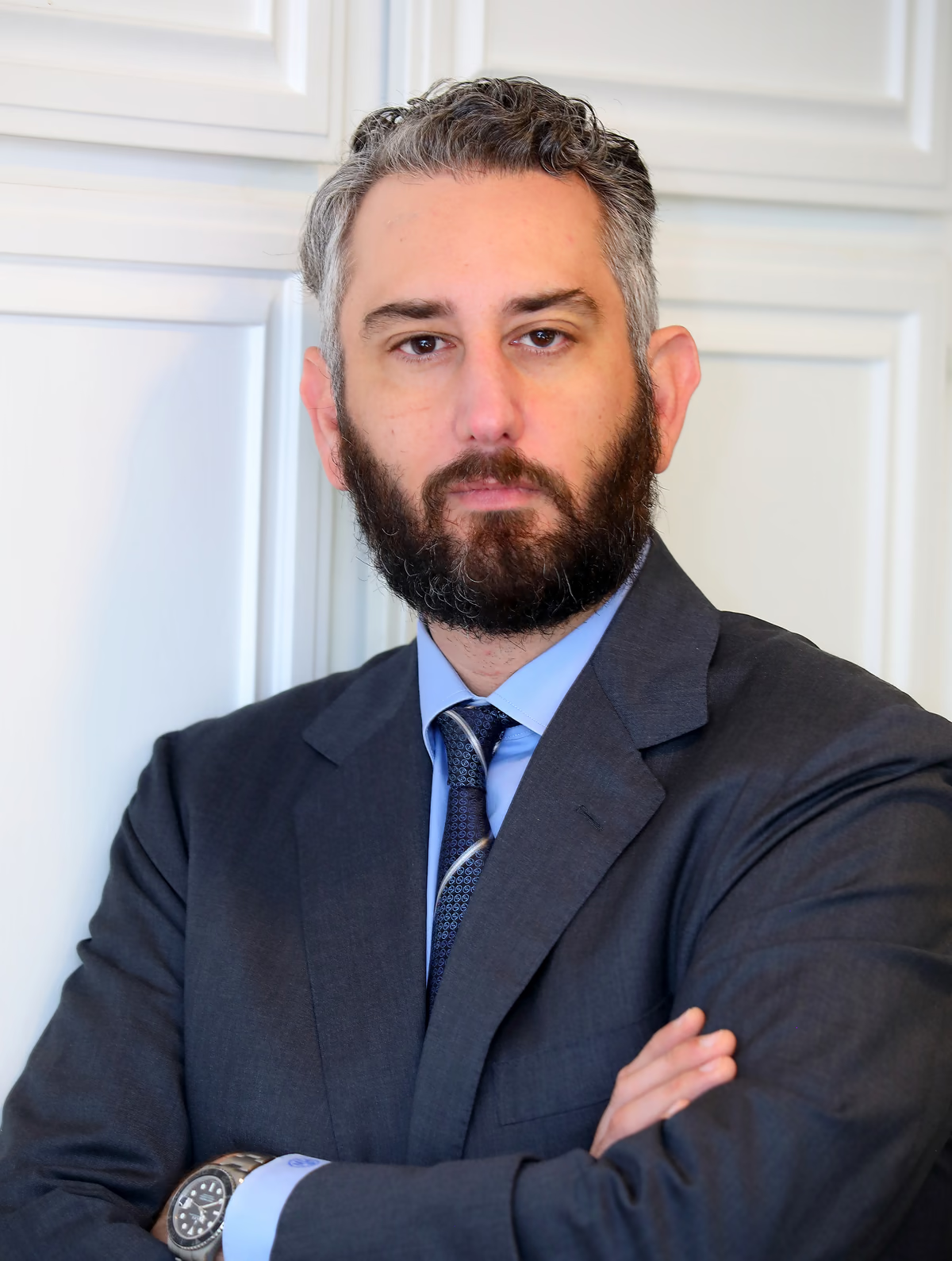
CA Bar #286995 · Admitted 2013
A rider may leave by ambulance while the motorcycle, helmet, gear, and broken parts leave separately. Within days, the bike may move from a tow yard to a shop or salvage facility, and its original condition may change before it is documented.
Medical care and immediate safety come first. Do not remain in traffic, return to a dangerous freeway, move debris, enter a restricted yard, or delay treatment to collect evidence. After urgent needs are addressed, promptly locate and preserve the motorcycle.
This article focuses on that problem. For a shorter immediate-action list, use the related Injury Help guide, Before Your Motorcycle Is Repaired or Scrapped.
Important: This article provides general information, not individualized legal or insurance advice. Duties, responsibility, coverage, evidence access, deadlines, and claim rights depend on the facts, contracts, policies, and law. No particular outcome, coverage, or payment is promised.
Separate Legal Duties From Practical Preservation Steps
California law imposes certain crash-related duties. Evidence preservation adds practical steps that are important but are not the same as statutory commands.
Depending on the facts, legal duties may include:
- Helmet use: Vehicle Code section 27803 requires a motorcycle driver and passenger riding on a highway to wear a qualifying safety helmet that is properly fitted and fastened. Section 27802 connects the helmet standard to federal requirements. Section 27803 contains a narrow exception for a fully enclosed three-wheeled motor vehicle that meets specified size, weight, and safety requirements.
- Stopping and helping: A driver involved in a crash that injures another person or causes death must stop. Vehicle Code section 20003 addresses identifying information and reasonable assistance.
- Information exchange: Vehicle Code section 16025 requires a capable driver to exchange specified driver, owner, vehicle-identification, and financial-responsibility information with another involved driver or a property owner present at the scene.
- A written report within 24 hours: Vehicle Code section 20008 requires the driver of a vehicle other than a common-carrier vehicle involved in a crash causing injury or death to make or cause a written report within 24 hours to CHP or, for a crash within a city, to CHP or that city's police department. This is a driver reporting duty, not a lawsuit deadline.
- An SR-1 within 10 days: Vehicle Code section 16000 and current DMV guidance require the driver to report a crash on a street or highway to DMV within 10 days when someone is injured or killed, or property damage exceeds $1,000 to any one person's property. DMV says the SR-1 is required in addition to a police, CHP, or insurance report. Section 16000(b) says this report is not required when the involved motor vehicle was owned or leased by, or under the direction of, the United States, a state, or a local agency.
California does not impose one universal crash statute requiring photographs, a preservation request, or a stop to every repair. Those practical measures should account for ownership, access, safety, and storage charges.
A preservation request asks a custodian to retain identified items for a stated period. It is not a subpoena, court order, automatic litigation hold, right of entry, or assurance that repair, sale, or disposal will stop. Ask for written confirmation of what will be held and until what date. Our article on evidence-preservation requests explains the limits.
Locate, Photograph, and Track the Motorcycle
Start with two questions: Where is the motorcycle, and who can authorize what happens next? Control may rest with the owner, lienholder, tow yard, shop, insurer, salvage company, police, or someone holding the keys, gear, or parts.
Record the location, custodian, arrival date, claim or inventory number, tow authorization, ownership or lender interest, access rules, and later transfers. Ask whether inspection, repair, lien proceedings, auction, title transfer, salvage, or scrap is scheduled. Save every notice and confirm important calls in writing. If police hold the bike, follow agency procedures; a private request does not create access to investigative evidence.
When it is safe and permission has been granted, photograph the motorcycle before it is cleaned, started, moved, dismantled, tested, or repaired. Capture:
- both sides, front, rear, overhead, safely visible underside, and storage position;
- VIN, plate, registration, make, model, year, mileage, keys, luggage, accessories, and aftermarket equipment;
- impact points, paint transfer, scratches, deformation, broken mounts, dashboard readings, and switch positions;
- tires, wheels, forks, frame, suspension, brakes, controls, lights, passenger area, and body panels; and
- every detached part, including small fasteners or fragments, with a record of who collected it and where it went.
Do not start, ride, or reenact the crash with a damaged motorcycle. Visible damage does not prove what failed first. A bent fork, broken brake, or frame fracture may result from impact, an earlier condition, maintenance, modification, design, repair, or another cause. Save purchase, maintenance, recall, modification, prior-damage, and repair records, plus pre-crash photographs.
Preserve Each Helmet and Set of Gear
Treat the rider's and passenger's helmets and gear as separate physical evidence. Photograph each helmet on every side and inside, including its identifying labels, shell, visor, strap, buckle, liner, communications equipment, and visible marks. Record who wore it and how it was fastened without guessing. Save purchase and known prior-impact or replacement history.
Also preserve the jacket, armor, airbag vest, gloves, boots, riding pants, eyewear, backpack, phone, camera, and other damaged items. Do not clean, repair, repaint, cut apart, test, or discard them. Do not keep wearing an impact-damaged helmet merely to preserve it; store it safely and follow product-specific safety instructions.
California's helmet rule does not make all protective apparel a statutory requirement under section 27803. DMV recommends additional protective clothing and gear, but the helmet statute does not require each jacket, glove, boot, or riding pant.
Helmet use or nonuse also does not automatically decide who caused the collision. It may be relevant to a claimed injury, particularly a head injury. But Evidence Code section 669 requires several conditions, including a causal connection between a statutory violation and the injury at issue, before its rebuttable presumption applies. Crash fault, injury causation, and comparative responsibility remain distinct questions.
Coordinate Tow, Storage, Repair, and Title Decisions
Tow and storage records establish custody and may contain fast-moving dates. Save pickup and authorization details, destination, intake records, invoice, daily rate, balance, access rules, inspection dates, and every movement, lien, auction, or sale notice.
Do not ignore accumulating storage charges, but do not authorize destruction of potentially important evidence without understanding the consequences. Prompt planning may allow photographs, a coordinated inspection, movement to safer or lower-cost storage, or another lawful arrangement. An insurer does not necessarily pay every tow or storage charge. Ask what policy and coverage it is discussing, what amount it accepts, what mitigation it expects, and when charges may stop; request important positions in writing.
Before authorizing work, identify whether a document permits storage, an estimate, diagnostics, disassembly, repair, destructive testing, parts disposal, or something broader. Business and Professions Code section 9884.9 addresses written estimates and authorization for automotive repair dealers; additional work and charges ordinarily require further authorization, subject to the statute and transaction. Save the estimate, work order, later authorizations, results, invoices, and replaced-parts instructions.
A total-loss decision concerns property handling and valuation. It does not decide crash fault, injury causation, or the value of a bodily-injury claim. Before signing a title, power-of-attorney, salvage, non-repairable, scrap, release, check, or electronic acceptance, ask what it transfers, where the bike and parts will go, when access ends, whether an inspection should occur first, and whether the language affects property damage only or also mentions bodily injury or other claims.
A custody or vehicle-release authorization may be different from a claim release, but one document can contain both. Read the full text for title-transfer, disposal, payment, and release language before signing.
Do not collapse “total loss,” “salvage,” and “non-repairable” into one term. DMV explains that a vehicle declared by its owner solely as a source of parts or scrap metal may be classified as non-repairable; once a non-repairable vehicle certificate is issued, it cannot later be titled or re-registered as a revived salvage vehicle. Ownership, financing, policy duties, safety, storage costs, and title rules may still require prompt decisions. Our related article explains why vehicle-damage and bodily-injury claims do not always settle together.
Save Scene, Camera, and Digital Evidence
When safely available, document the exact road, direction, lane, time, visibility, traffic, surface, markings, signals, sightlines, construction or hazards, vehicle positions, marks, and witness or responder identifiers.
Identify storefront, residential, doorbell, parking, transit, traffic, construction, helmet, vehicle, and dash cameras. Record the custodian and a reasonable time window before and after impact because recordings may be overwritten quickly. Ask for preservation without trespassing, demanding private footage, impersonating an officer, or assuming a right to obtain it.
Keep original photographs and video with metadata; do not replace untouched masters with edited copies. Save relevant messages, maps, routes, and connected-device records. Some motorcycles, cameras, phones, or connected systems may contain useful data, but availability, ownership, access, and interpretation vary. Extraction may require permission and technical assistance. Do not claim every motorcycle has a recoverable crash recorder or bypass protected systems.
Investigate Fault Without Automatic Conclusions
Vehicle Code section 21658.1 defines lane splitting as driving a motorcycle, as defined in section 400, that has two wheels in contact with the ground, between rows of stopped or moving vehicles in the same lane, including on divided and undivided streets, roads, or highways. That definition does not create a universal safe speed or decide civil responsibility. If alleged, preserve evidence about traffic and rider speed, position, visibility, driver movements, signals, braking, witnesses, video, and final positions. Lane splitting is not automatically lawful, unlawful, careful, or negligent in every situation.
Responsibility may require separate investigation of:
- rider conduct, including speed, position, visibility, distraction, impairment, maintenance, modifications, and helmet use—none an automatic fault finding;
- another driver or owner, including turns, yielding, lane changes, door openings, distraction, ownership, permission, insurance, and vehicle use;
- roadway or private-property control, the precise condition, causation, maintenance, notice, and custodian;
- product, maintenance, or repair questions involving the bike, helmet, accessories, warnings, service, or modifications—damage or a recall alone does not prove defect or causation; and
- supported commercial or employer involvement; a logo or work trip alone does not decide responsibility.
A police or CHP report is important, but it is not the final word on civil fault. Compare it with physical evidence, original files, witnesses, medical records, and later corrections or supplements.
Keep Rider, Passenger, Property, and Coverage Records Separate
Each injured rider and passenger should maintain an independent medical and loss file: treatment records, instructions, prescriptions, restrictions, injury photographs, an accurate symptom chronology, bills, explanations of benefits, expenses, and work or income records. Medical decisions should follow health needs, not claim value. Do not diagnose from motorcycle damage or misstate prior conditions and changed symptoms.
A passenger should not rely on the rider to preserve the passenger's helmet, medical file, communications, or coverage information. See what an injured passenger should save.
Insurance categories may include another driver's bodily-injury liability; motorcycle collision, comprehensive, or custom-equipment coverage; UM/UIM bodily injury; uninsured-motorist property damage when applicable; medical payments; health insurance; and fact-supported commercial, employer, premises, product, or public-entity routes. Possible policies do not mean each applies or permit duplicate payment for the same loss.
Property issues may include the bike, gear, tow, storage, and transportation. Bodily-injury issues may include medical effects, income loss, and other claimed losses. A property payment or total-loss decision does not necessarily resolve bodily injury.
Do not refuse all communication with your own insurer. Policy duties may require prompt notice, information, inspection, or cooperation. Be truthful, do not guess, keep copies, and identify the policy, claim, and coverage before giving a broad recorded statement or signing a document. Use our insurance-adjuster call guide for a separate checklist.
Reporting and Other Timing Issues
The 24-hour written CHP or city-police report and 10-day DMV SR-1 described above do different jobs and are not universal lawsuit deadlines. The SR-1 does not replace a police, CHP, insurer, government-claim, or preservation step.
For the specified unknown-owner-or-operator uninsured-motorist bodily-injury route, Insurance Code section 11580.2 requires physical contact, a report within 24 hours to the agency specified by the statute, and a sworn statement filed with the insurer within 30 days after that report. These are coverage conditions, not universal crash or lawsuit deadlines. See our California hit-and-run guide.
A public-entity issue needs separate and prompt analysis. Government Code section 911.2 generally requires a claim relating to personal injury, death, or personal property to be presented no later than six months after accrual. The correct entity, accrual, claim type, recipient, exceptions, late-claim procedures, immunities, and later lawsuit timing may change the analysis. An insurance claim, SR-1, police report, or preservation request does not replace a government claim.
Camera overwriting, storage notices, repair, title transfer, and salvage movement may occur much sooner. There is no one universal statutory deadline for all of them; review the actual policy, notice, repair order, and custody record promptly.
Five Frequently Asked Questions
Should I refuse all repairs or refuse to release the motorcycle?
Not as a blanket rule. Ask what is planned and request a short written pause while photographs or an inspection are considered. Ownership, policy duties, safety, contracts, and storage charges may affect the decision. Document the bike before any authorized change when safely possible. A custody authorization and a claim release do different jobs, but one document may contain both; read the entire document before signing.
Does lane splitting make a rider automatically at fault?
No. Lane splitting, speed, traffic, visibility, driver movements, and other facts may all be investigated. The statutory definition does not decide civil responsibility by itself.
What if the rider was not wearing a compliant helmet?
Helmet nonuse may be relevant to a claimed injury, particularly a head injury, but it does not automatically identify who caused the collision or eliminate another person's possible negligence. Causation and comparative responsibility require a fact-specific analysis.
What if the insurer says the motorcycle is a total loss?
Ask where the bike is, who controls it, when it will move, what title document is requested, and whether photographs or an inspection should happen first. A total-loss property decision does not decide crash fault, injury causation, or bodily-injury claim value.
Can an injured motorcycle passenger have a separate claim?
Possibly, depending on the facts and applicable law and policies. The passenger should preserve a separate helmet and gear record, medical file, communications, and information for every driver, owner, and insurer. A relationship with the rider does not decide coverage or responsibility.
Official Sources
- California Vehicle Code section 21658.1: Lane splitting
- California Vehicle Code section 27802: Motorcycle helmet standards
- California Vehicle Code section 27803: Motorcycle helmet use
- California Vehicle Code section 20001: Duty to stop after an injury or death crash
- California Vehicle Code section 20003: Information and reasonable assistance
- California Vehicle Code section 20008: 24-hour written report
- California Vehicle Code section 16000: DMV accident reporting
- California Vehicle Code section 16025: Information exchange
- California DMV: Accident Reporting and SR-1
- California DMV: Motorcyclists Guide
- California Highway Patrol: Traffic and crash-report information
- California Department of Insurance: Automobile Insurance Guide
- California Business and Professions Code section 9884.9: Repair estimates and authorization
- California Bureau of Automotive Repair: Auto Repairs
- California DMV: Total Loss Salvage and Non-Repairable Vehicles
- California Civil Code section 1714
- California Evidence Code section 669
- California Insurance Code section 11580.2
- California Government Code section 911.2
Bottom Line
After medical and safety needs are addressed, locate the motorcycle, helmet, gear, and detached parts. Identify who controls each item, photograph original condition, save custody and storage records, and read repair, total-loss, title, and scrap paperwork before authorizing a change. Keep property, bodily-injury, coverage, reporting, and responsibility questions in separate lanes.
Law Office of Arta Wildeboer helps injured riders and passengers in Downey, Southeast Los Angeles, the Gateway Cities, and throughout Southern California evaluate serious crash evidence, insurance documents, and time-sensitive preservation questions. Learn more about the firm's California personal injury services.
Call or text (562) 608-8887 or contact Law Office of Arta Wildeboer online for a free consultation about the specific facts.
Se habla español. Farsi and Filipino/Tagalog assistance are also available.
Past results do not promise any outcome. This article is general information and is not legal advice. Contacting the firm does not create an attorney-client relationship unless a written agreement is signed.
Attorney Advertising. This article is for general informational purposes only and does not constitute legal advice. Reading this content does not create an attorney-client relationship. Laws change frequently — consult a qualified attorney about your specific situation.